Tattoo guides
How to Choose a Tattoo Style
Compare line weight, shading, colour and overall shape before choosing a style label. Then find an artist whose healed work matches the result you want.
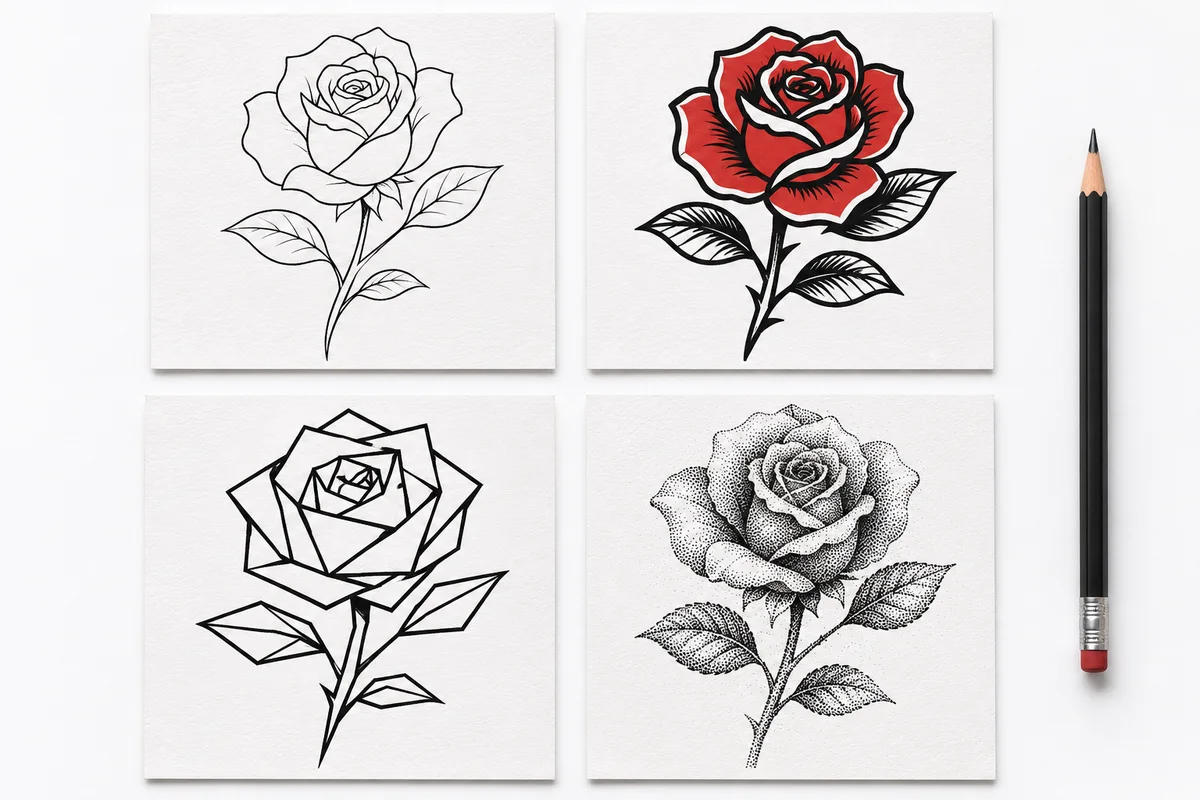
Start with what you see
Save a small selection of references and describe what attracts you to each one. Is it the thin outline, solid dark areas, soft shading or a bold silhouette? This is more useful than choosing a style name because it is popular.
The same subject can be interpreted in several ways. A rose might be a simple contour, a graphic red-and-black motif or a shaded drawing. The cover illustration explores these visual choices; it is not an artist portfolio or a prediction of healed results.
Compare a few directions
- Fine line: consider the delicacy of the lines and how much detail you want within the available space.
- Blackwork: look at solid black areas and the shape of the open skin around them.
- Traditional: compare bold outlines, simplified shapes and restrained colour choices.
- Realism: look closely at the source photograph, tonal detail and the artist's comparable work.
- Geometric: consider repeated shapes, alignment and how the pattern fits the body.
These are starting points for a discussion, not rigid categories. A studio's own terminology may differ. For one practitioner's description of traditional work, see Cloak & Dagger's style page.
Consider size and placement together
Ask to see the design at the intended size, not only zoomed in on a screen. Compare the outline from a normal viewing distance and consider the way the area moves. Explain how visible you want the tattoo to be in everyday clothing.
Ask what would need to change if you chose a smaller size. You may prefer fewer elements, wider spacing or a different placement after seeing a stencil. Avoid assuming that every detailed reference can simply be scaled down.
Use a portfolio as a conversation
Look for repeated examples of the effect you want, rather than one exceptional image. Request healed photographs where available and ask whether filters or editing affect the presentation. For colour work, ask about comparable work on skin tones like yours without treating one photo as a guaranteed outcome.
Do not choose an artist solely because they are nearby or available immediately. Equally, do not assume a famous artist specialises in every style. Ask who will draw and tattoo your piece.
Build a useful reference brief
Separate the subject from the style: for example, "a botanical branch with open spacing and a fine outline" is clearer than "something minimalist". Mark what you like in each reference and what you want changed. Credit the source where known and invite an original composition.
For cultural or religious imagery, research its context and seek appropriate expertise before treating it as decoration. For lettering, verify the exact spelling and translation independently before approving it.
Next, discuss the budget and read the consultation checklist.
Sources and editorial note
Sources checked 19 November 2026. This is an editorial guide, not individual medical or legal advice. No clinician review is claimed. Studio references illustrate one provider's approach, not an endorsement or universal policy.
Common questions
Can two tattoo styles be combined?
They can be discussed in one brief, but ask the artist how the different line weights, colours and shapes will work together. A clear composition matters more than combining labels.
Which style lasts best?
There is no universal winner for every tattoo. Discuss size, spacing, contrast and healed examples with the artist instead of relying on a style label as a guarantee.
Do I need to know the style name before contacting an artist?
No. A few references with notes about what you like can be more useful than an uncertain label.